May 22

The Will – a Peer Review Strategy for Virtual Gallery Walks

The “Will” Peer Review Strategy for Virtual Gallery Walks and other Online Peer Review

A Gallery Walk is a small group to whole group culminating activity in which student work is displayed. In traditional gallery walks, participants view each other’s work and comment with extemporaneous comments or a critical thinking schema (Jonson, 2005; Delgado, 2006; Frank & Krueger, 2025; Omiles & Ramirez, 2025).

In a digital update, a virtual gallery walk is an interactive learning experience with three steps.

Step 1 – Student designers create a digital artifact such as video, audio performance, original art work, slide deck, Google Slides presentations, Infographics, or Concept maps.

Step 2 – Students display their digital artifact, usually through posting in a threaded discussion forum or displayed in a virtual gallery format, similar to a physical art gallery walk. 

Step 3 – All students in a group or class click-walk through the uploaded digital learning artifacts in preparation for Step 4.

Step 4 Rationale – In order to provide deeper meaning and reinforce collaborative, socio-cultural learning, a review strategy is utilized. Previous posts in the 10-Rep Learning blog have featured the P*N*I Peer Review Strategy in Digital and Face-to-Face Gallery Walks. Teague’s 10-Rep Learning P*N*I strategy (2026) is an adaptation of Edward de Bono’s PMI Lateral Thinking strategy (1970).
Another strategy to try is the “Will” Peer Review Strategy. The “Will” acronym stands for “What I Learned + Liked.” Students from grades 5 through 12 view the digitally uploaded artifacts (or links to the artifacts) and provide a reply post or digital caption following the letters in the word “Will” “What I Learned + Liked” or “What I Liked + Learned.”

     The “Will” Peer Review Strategy also is engaging for Adult Learners. Teachers and Instructors can vary the complexity of the “Will” statement with additional criteria. For teacher candidates in undergraduate or graduate online courses, the second sentence about what learning occurred may include what the viewer learned that would be effective for classroom use. For Adult Learners, responses reflect in-text and ending citations from the required studies and/or their own research. 

Step 4 Task Instructions: Please view your peers projects [i.e learning artifacts]. Next, post a 2-sentence Reply post summarizing your positive impression of the project [i.e. Learning artifact]. Compose a second sentence that describes what you learned. Begin your sentence with the name of the video creator. Optional: Conclude your WILL response with a question for the video creator to consider in reply to you.

Format example: Student “Will Reply”: What I Liked and Learned about Javier’s Concept Map on Cybersecurity: I Liked that Javier use two languages in the thought bubbles. What I Learned was that passwords need to be changed every 90 days.
Undergraduate/Graduate Student “Will” Reply: Javier, What I Learned from your Concept Map on Cybersecurity is that it will be effective on my classroom routines to prompt student’s to change their passwords every 90 days (Santana, 2025) and I will add this activity to my Google Calendar. What I liked about your Concept Map on Cybersecurity was its uncluttered design and text-to-background contrast that made it easier for me to read.


Core Message: Online and Digital Gallery Walk collaborative reflection strategies can increase collaborative support and dialogue through the “Will” reply strategy.

                                                               References

De Bono, E., & Zimbalist, E. (1970). Lateral thinking (pp. 1-32).  Penguin.

Delgado, R. A. (2006). Gallery Walk activity protocol. Education Consortium, LLC. https://campussuite-storage.s3.amazonaws.com/prod/1559107/a32ad7b8-90dc-11ec-98ec-0ad3f63f6779/2448636/b1651e1e-09b4-11ed-b18c-02679c9b5d8d/file/Gallery%20Walk%20Activity.pdf

Frank, R., & Krueger, S. (2025). Gallery walk as research method in information science. Information Research an international electronic journal30(iConf), 171-179. https://doi.org/10.47989/ir30iConf47554

Gehringer, E.F., (2000). Strategies and mechanisms for electronic peer review. In 30th Annual Frontiers in Education Conference. Building on A Century of Progress in Engineering Education. Conference Proceedings (IEEE Cat. No. 00CH37135) (Vol. 1, pp. F1B-2). IEEE. Retrieved from Strategies and Mechanisms for Electronic Peer

Jonson, K. F. (2005). 60 Strategies for improving reading comprehension in Grades K-8. Corwin Press. Google Books Link.

Omiles, M. E., & Ramirez, E. J. D. (2025). Peer Learning Framework in The New Normal. Journal of Practical Studies in Education, 6(1), 14-25.

Santana, M. D. (2025). Eliminating the security weakness of Linux and UNIX Operating Systems. In Computer and information security handbook(p. 217-233). Morgan Kaufmann.

Teague, H. (2009). Peer Review. 10-Rep Learning. Edublogs. https://4oops.edublogs.org/2009/07/06/peer-review/

Teague, H. (2016). Peer Review Implementation. 10-Rep Learning. Edublogs. https://4oops.edublogs.org/2016/09/15/peerreviewimplementation/

Teague, H. (2018). The PMI and P*N*I (Adapted) Peer Review Schema. 10-Rep Learning. Edublogs. https://4oops.edublogs.org/2018/06/26/pnipeerreviewteague/
March 1

Weekend Ed. Quote ~ March 1, 2024

“Peer review allows students to clarify their own ideas as they explain them to classmates and as they formulate questions about their classmates’ writing. This is helpful to writers at all skill levels, in all classes, and at all stages of the writing process.”
~Southwestern University


                                                                                    References

Southwestern University (2020). Benefits of peer review.
https://www.southwestern.edu/offices/writing/faculty-resources-for-writing-instruction/peer-review/benefits-of-peer-review/#:~:text=Peer%20review%20allows%20students%20to,stages%20of%20the%20writing%20process.


More Weekend Ed. Quotes

#GCUTEC544 #GCUTEC595 #GCUTEC516 #GCUTEC521
#CUNE604, #CUNE605

June 26

The PMI and P*N*I (Adapted) Peer Review Schema

For generations, the academic community has relied on peer review as a way of enhancing the knowledge base and encouraging serious scholarship. Peer review can offer many of the same benefit to students… [and] computers [can] mediate the interaction among peers (Gehringer, 2000).

  • Peer Review reflects constructive guidance at its collaborative best.
  • As an application to the classroom, Peer Review helps students and the teacher.
  • Anonymous Peer Review provides a framework for students to learn balanced reasoning at a time when modern discourse often descends into shouting and insults

Peer Reviews are most effective when combined with an evaluative schema such as the P*M*I thinking strategy, created by French physician, psychologist, philosopher, author, inventor Edward deBono. In the P*M*I strategy: 

P=Pluses 

M=Minuses

I= Interesting Points

When using a thinking schema such as P*M*I, in an anonymous Peer Review, students learn how to offer points of help, practice proofreading, and strengthen other communication skills.

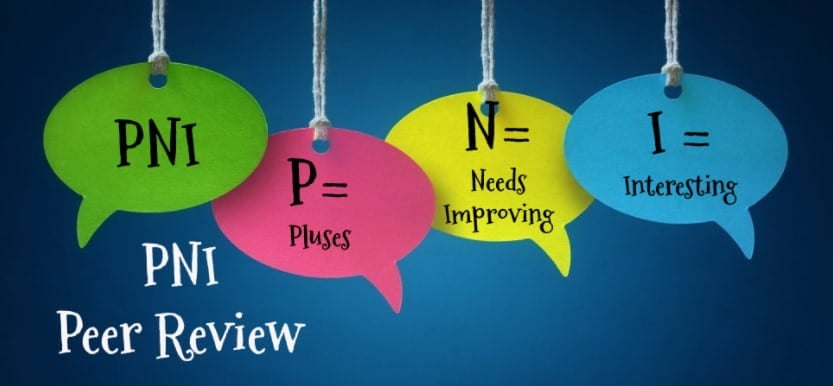
Ten years’ ago, I created the P*N*I peer review schema as an adaptation of Dr. DeBono’s original thinking strategy. In the P*N*I Peer Review strategy:

P=Pluses (something you find that is a “Plus”

N=Needs A Look (something you find that “Needs Another Look” for possible correction)

I=  (something you find that is interesting and/or thought-provoking)

Among the benefits of both the original P*M*I and P*N*I formats are the following:

  • Peer Review introduces and encourages diversity of opinion
  • Peer Review models the importance of checking work before it is turned in. When the audience is the teacher alone, sadly, many students are apathetic. But when the audience is the students’ fellow classmates, an extra attention to detail emerges.
  • Peer Review offers students a practical application in this real-world review.

Peer Review provides a review committee for the teacher who often has, to butcher Robert Frost, “miles to grade before she sleeps.”

PNI Schema Helen Teague

References

De Bono, E., & Zimbalist, E. (1970). Lateral thinking (pp. 1-32). Penguin.

Gehringer, E.F., (2000). Strategies and mechanisms for electronic peer review. In 30th Annual Frontiers in Education Conference. Building on A Century of Progress in Engineering Education. Conference Proceedings (IEEE Cat. No. 00CH37135) (Vol. 1, pp. F1B-2). IEEE. Retrieved from Strategies and Mechanisms for Electronic Peer

Teague, H. (2009). Peer Review. 10-Rep Learning. Edublogs. https://4oops.edublogs.org/2009/07/06/peer-review/

Teague, H. (2016). Peer Review Implementation. 10-Rep Learning. Edublogs. https://4oops.edublogs.org/2016/09/15/peerreviewimplementation/

Teague, H. (2018). The PMI and P*N*I (Adapted) Peer Review Schema. 10-Rep Learning. Edublogs. https://4oops.edublogs.org/2018/06/26/pnipeerreviewteague/
September 15

Peer Review Implementation

Thoughts on Peer Review for my PBS Learners (and you too!)

As you proceed to Peer Review each other’s work, consider using the P*M*I strategy from Edward deBono:

P=Pluses (something you find that is a “Plus”)

M=Minuses (errors)

I= Interesting (something you find that is interesting)


For generations, the academic community has relied on peer review as a way of enhancing the knowledge base and encouraging serious scholarship. Peer review can offer many of the same benefit to students… [and] computers [can] mediate the interaction among peers. Gehringer (2000)

  • Peer Review reflects constructive guidance at its collaborative best.
  • As an application to the classroom, Peer Review helps students and the teacher.
  • Anonymous Peer Review provides a framework for students to learn balanced reasoning at a time when modern discourse often descends into shouting and insults
  • Anonymous Peer Review teaches students how to offer points of help, practice proofreading, and strengthen other communication skills.
  • Peer Review introduces and encourages diversity of opinion
  • Peer Review models the importance of checking work before it is turned in. When the audience is the teacher alone, sadly, many students are apathetic. But when the audience is the students’ fellow classmates, an extra attention to detail emerges.
  • Peer Review offers students a practical application in this real-world review.

I adapted the P*M*I schema to reflect new acronyms. The adapted acronym is a new thinking schema called P*N*I and you can use this schema in your reviews:

      P=Pluses (something you find that is a “Plus”)

      N=Needs A Look (something you find that “Needs Another Look” for possible correction)

      I= Interesting (something you find that is interesting)

In the P*N*I adapted strategy, the original “M for Minus” component is altered to the letter “N” for Needs Attention. The Rationale for this change is that most Learners in online environments are learning alone and without the cues of group interaction. The words “Needs Attention” are softer and potentially less rigid that deBono’s original M for Minus.


Here is a sample Peer Review

Dear ________
Your commitment to this project and for special needs students really shines in this project. Pluses: 1.) You’re very thorough and thoughtful in your project and I did not see any typos or grammar errors. 2.) You’ve worked to make your project inclusive for all students. 3.) You did a great job of integrating technology such as Promethean Boards, e-books, Audiobooks, etc.  4.)  Your project is positive and empowers students!
Needs Another Look: 1.) One of the ways to make your project stronger would be to check your APA citations with the guidelines on the Purdue website. 2.) Please check your Title Page to conform to APA guidelines
Interesting Points: 1.) It is interesting that you intend to build Learning Centers. 2.) Do you have budget money for hardware like earbuds, earphones, players? Are there state or county resources that may be utilized to help with this?
This concludes my review… thank you! 


Peer Review provides a fair perspective approach for students and a review committee for the teacher who often has, to butcher Robert Frost, “miles to grade before she sleeps.”

See what you can do to implement Peer Reviews in your classes!
Dr. Teague*  

PNI Schema Helen Teague


Previous Teague post: From this blog post: https://4oops.edublogs.org/2009/07/06/peer-review/

If you would like more information on methods for Student Use, please refer to this link:
http://serc.carleton.edu/introgeo/peerreview/studentintro.html

For forms to use with students, see this link: http://serc.carleton.edu/introgeo/peerreview/forms.html and http://www.scribd.com/doc/2205303/English-122-paper-one-peer-review


References

De Bono, E., & Zimbalist, E. (1970). Lateral thinking (pp. 1-32). Penguin.

Gehringer, E.F., 2000. Strategies and Mechanisms for Electronic Peer

Teague, H. (2009). Peer Review. 10-Rep Learning. Edublogs. https://4oops.edublogs.org/2009/07/06/peer-review/

Teague, H. (2016). Peer Review Implementation. 10-Rep Learning. Edublogs. https://4oops.edublogs.org/2016/09/15/peerreviewimplementation/


* (title updated 4-2017)

July 6

Peer Review


 For generations, the academic community has relied on peer review as a way of enhancing the knowledge base and encouraging serious scholarship. Peer review can offer many of the same benefit to students… [and] computers [can] mediate the interaction among peers. Gehringer (2000)


·        Peer Review reflects constructive guidance at its collaborative best.


·        As an application to the classroom, Peer Review helps students and the teacher.


·        Anonymous Peer Review provides a framework for students to learn balanced reasoning at a time when modern discourse often descends into shouting and insults (and that is just on CNN and MSNBC!)


·        When using a thinking schema such as P*M*I, anonymous Peer Review teaches students how to offer points of help, practice proofreading, and strengthen other communication skills.


·        Peer Review introduces and encourages diversity of opinion


·        Peer Review models the importance of checking work before it is turned in. When the audience is the teacher alone, sadly, many students are apathetic. But when the audience is the students’ fellow classmates, an extra attention to detail emerges.


·        Peer Review offers students a practical application in this real-world review.

The P*N*I Peer Review strategy (Teague, 2009) is adapted from deBono’s work and is customized for online learning spaces.

In the P*N*I adapted strategy, the original “M for Minus” component is altered to the letter “N” for Needs Attention. The Rationale for this change is that most Learners in online environments are learning alone and without the cues of group interaction. The words “Needs Attention” are softer and potentially less rigid that deBono’s original M for Minus.

PNIWordBubblesNeedsAttention


Peer Review provides a review committee for the teacher who often has, to butcher Robert Frost, “miles to grade before she sleeps.”


If you would like more information on methods for Student Use, please refer to this link:

http://serc.carleton.edu/introgeo/peerreview/studentintro.html

For forms to use with students, see this link: http://serc.carleton.edu/introgeo/peerreview/forms.html  and http://www.scribd.com/doc/2205303/English-122-paper-one-peer-review


References

De Bono, E., & Zimbalist, E. (1970). Lateral thinking (pp. 1-32). Penguin.

Gehringer, E.F., 2000. Strategies and Mechanisms for Electronic Peer Review

Teague, H. (2009). Peer Review. 10-Rep Learning. Edublogs. https://4oops.edublogs.org/2009/07/06/peer-review/