Category: Current Research, Educational Philosophy, Post Feed
Tags: Amelia Wildman, American educational philosophy, Etienne Wenger, Helen Teague, Jean Lave, Learner-centered, Lev Vygotsky, Linda Polin, Sasha Barab, survey
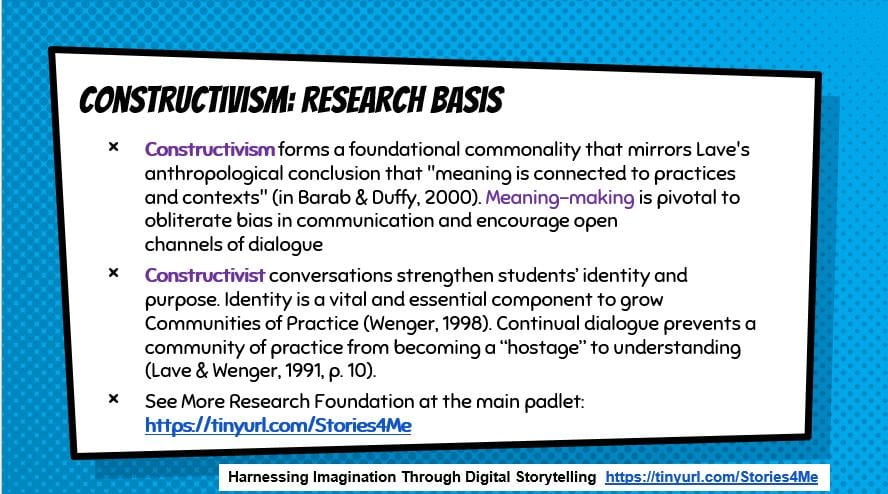
Learner-Centric Survey Research Focus
References
Asmara, J. (2023). Pre-print- Online Learning in supporting students’ procedural abilities viewed from a Constructivist approach. Universitas Negeri Surabaya. https://doi.org/10.21203/rs.3.rs-3466684/v1.
Barab, S. A., & Duffy, T. (2000). From practice fields to communities of practice. In D. Jonassen & S. M.Land(Eds.), Theoretical foundations of learning environments (pp. 25–56). Lawrence Erlbaum Associates, Inc.
Chelliq, I., Anoir, L., Erradi, M., & Khaldi, M. (2023). Transition from Face-to-Face to E-Learning and pedagogical model. In Emerging Trends and Historical Perspectives Surrounding Digital Transformation in Education: Achieving Open and Blended Learning Environments (pp. 52-77). IGI Global.
Cleveland-Innes, M., Garrison, R., & Kinsel, E. (2007). Role adjustment for learners in an online community of inquiry: Identifying the challenges of incoming online learners. International Journal of Web-Based Learning and Teaching Technologies (IJWLTT), 2(1), 1-16.
de Oliveira, A. M., & Schmitt, M. A. R.(2023). Google Classroom in the teaching and learning process From Piaget’s perspective. International Journal of Arts and Social Science (6)9 www.ijassjournal.com ISSN: 2581-7922, Volume 6 Issue 9, September 2023
Larson, B. E., & Keiper, T. A. (2002). Classroom discussion and threaded electronic discussion: Learning in two arenas. Contemporary Issues in Technology and Teacher Education, 2(1), 45-62.
Lave, J., & Wenger, E. (1991). Situated learning: Legitimate peripheral participation. Cambridge University Press.
Piaget, J. (1970). Psychology and Epistemology: Towards a theory of knowledge. Penguin Books
Szabó, F., & Csépes, I. (2023). Constructivism in language pedagogy. Hungarian Educational Research Journal,13(3), 405-417.
Vygotsky, L. (1978). Mind in Society: Development of higher psychological processes. (M. Cole, V. Jolm-Steiner, S. Scribner, & E. Souberman, Eds.). Harvard University Press. https://doi.org/10.2307/j.ctvjf9vz4
Wenger, E. (2011). Communities of practice: A brief introduction. University of Oregon. Link
Wenger, E. (1998). Communities of practice: Learning, meaning, and identity. Cambridge University Press.
Wenger, E. (1998). Communities of practice: Learning as a social system. Systems thinker, 9(5), 2-3.
*in papers




 :
: