10-Rep Learning ~ Teague's Tech Treks

Learning Technology & Tech Observations by Dr. Helen Teague

By

Weekend Ed. Quote ~ March 13

Our Weekend Ed. Quote features a timeline of 200 years with a quote from the 1800’s and an image generated by DeepAI ~ yesterday. 

“Young people must break machines to learn how to use them; get another made!” ~ English scientist Henry Cavendish (1731–1810), as quoted in Biographical Memoir of Henry Cavendish by the French naturalist and zoologist Georges Cuvier.

Image of Cavendish Quote by DeepAI

Photo generated by DeepAI, Deepai.org


Henry Cavendish is the scientist who is 1798 effectively “weighed” the Earth — without leaving his laboratory. Cavendish reportedly made this remark when he was informed that a young man had broken one of his expensive and valuable scientific instruments. Despite being famously shy and reclusive, this quote reflects a surprisingly pragmatic view of scientific education—that the cost of broken equipment was a necessary investment in the learning process of the next generation. Breaking, making, and tinkering would continue to influence Learning through the theoretical endeavors of Seymour Papert, Kolb, and Seimens. 


                                      References

Cuvier, G. (1828). Biographical memoir of Henry Cavendish. The Edinburgh New Philosophical Journal. p.222.

and https://en.wikiquote.org/wiki/Henry_Cavendish


More Weekend Ed. Quotes

#GCUTEC544 #GCUTEC595 #GCUTEC516
#CUNE604, #CUNE605 #CUNE603

By

Planning for STEAM Lessons: 5E, Differentiation, and Learning Theories

Planning for STEAM Lessons: 5E, Differentiation, and Learning Theories


The 5E learning cycle is an instructional model based on the Constructivist and Constructionist theoretical approaches to learning. Constructivism identifies that learners build or construct new ideas on top of their old ideas by interacting with the world, ideas, and others (Ackermann, 2012; Piaget, 1954; Polin, 2018; Tucker, 2021).

Through Constructionism, learning is not only transmitted (Piaget, 1954;Polin, 2018) but reconstructed by the learner in activity – specifically the active construction of a meaningful product (Papert, 1987; Papert & Harel, 1991). Through the reconstructing process, both the Constructivist and Constructionist learning theory are especially relevant to STEAM learning (Papert, 1987; Wiggins, 2015).

The 5E approach to lesson planning, developed by Rodger Bybee in 1987, allows learners to interact with and experience ideas to build their knowledge of phenomena (International Science Teaching Foundation, 2024; Tucker, 2020; Zusy, 2025).

What is your Prior Knowledge of the 5E model, either as an Instructional Framework or a Lesson Planning approach?

                                                                        References

Ackermann, E. (2012). Construction and transference of meaning through form. In Constructivism in education (pp. 341-354). Routledge.

International Science Teaching Foundation, (2024). The Cognitive Principles of Learning Underlying the 5E Model of Instruction. https://science-teaching.org/research/the-cognitive-principles-of-learning-underlying-the-5e-model-of-instruction

Papert, S. A. (1987). Constructionism: A new opportunity for elementary science education. NSF Award Number 8751190. Directorate for STEM Education87(8751190), 51190.

Papert, S., & Harel, I. (1991). Situating Constructionism. Constructionism36(2), 1-11. http://www.papert.org/articles/SituatingConstructionism.html.

Piaget, J. (1954). The Construction of Reality in the Child. Ballantine Books.

Polin, L. G. (2018). A constructivist perspective on games in education. In Constructivist education in an age of accountability (pp. 163-188). Cham: Springer International Publishing.

Tucker, C. (2020). Tips for designing an online learning experience using the 5E instructional model. https://catlintucker.com/2020/03/designing-an-online-lesson/

Tucker, C. (2021). Universally Designed Blended Learning. https://catlintucker.com/2021/05/universally-designed-blended-learning/

Wiggins, J. (2015). Constructivism, policy, and arts education. Arts Education Policy Review116(3), 115-117.

Zusy, S. (2025). The 5E Model: 5 steps to motivate student learning. Gale Publishing Blog. https://blog.gale.com/the-5e-model-5-steps-to-motivate-student-learning/


By

Video Review of Constructivism and Constructionism

Here is an updated video review of the Constructivism and Constructionism Learning Theories.

The video features a Microsoft digital storytelling app for creating interactive presentation called Sway. Here is the Sway link if you would like to scroll through at your own pace: https://tinyurl.com/TeagueSwayPVP

Vimeo video link: https://vimeo.com/teaguetech/piagetvygotskypapert?share=copy


Please note: This is a video excerpt from a Webinar I gave for graduate students and presented onsite in Tampere, Finland and Dublin, Ireland. This is a very low-tech, summary version of a much longer conference presentation. Participant questions and discussion are edited and gaps may be present. The video has been edited for time and content. Some edits are choppy and will never win awards. 🙂

By

Weekend Ed. Quote ~ April 30


“… the original decision about how to use computers placed the teacher on a collision course with School’s system of control: As soon as she (the teacher) decided not to control the students, she took away School’s established way of controlling her. The question has moved from how power is distributed within the educational hierarchy to whether hierarchy to whether hierarchy is an appropriate mode of organization for education.”

~Seymour Papert, The Children’s Machine: Rethinking school in the age of the computer, 1993


Legos


Reference

Papert, S. (1993). The Children’s Machine Rethinking school in the age of the computer. Basic Books.


More Weekend Ed. Quotes

By

Weekend Ed. Quote ~ April 9

SPapert


File Link: https://4oops.edublogs.org/files/2021/04/PapertP42.jpg

More Quotes from Seymour Papert

More Weekend Ed. Quotes

By

Enduring Value In Online Courses & Beyond!

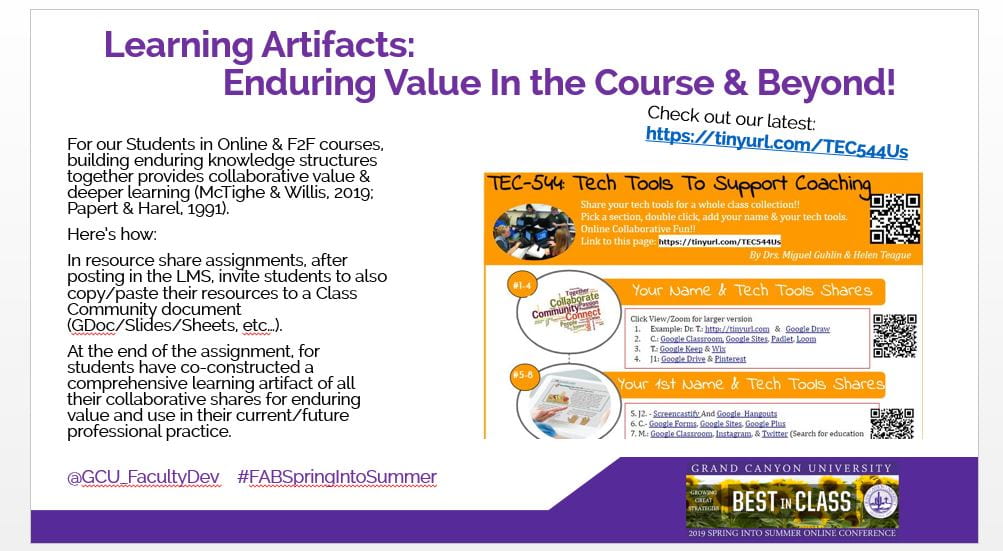
For our Students in Online & F2F courses, (such as those offered by PBS TeacherLine and GCU) subuilding enduring knowledge structures together provides collaborative value & deeper learning (McTighe & Willis, 2019; Papert & Harel, 1991).

Here’s how:

In resource share assignments, after posting in the LMS, invite students to also copy/paste their resources to a Class Community document (GDoc/Slides/Sheets, etc…).

At the end of the assignment, for students have co-constructed a comprehensive learning artifact of all their collaborative shares for enduring value and use in their current/future professional practice.

GCU Tweet Contest


Check out our latest enduring value share: https://tinyurl.com/TEC544Us

~~~~

@GCU_FacultyDev #FABSpringIntoSummer


By

Weekend Ed. Quote ~ July 7

“Nothing could be more absurd than an experiment in which Edtech is placed in a classroom where nothing else is changed.” ~Seymour Papert

Revised Blooms


~~~

More Weekend Ed. Quotes

By

Weekend Ed. Quote ~ October 7

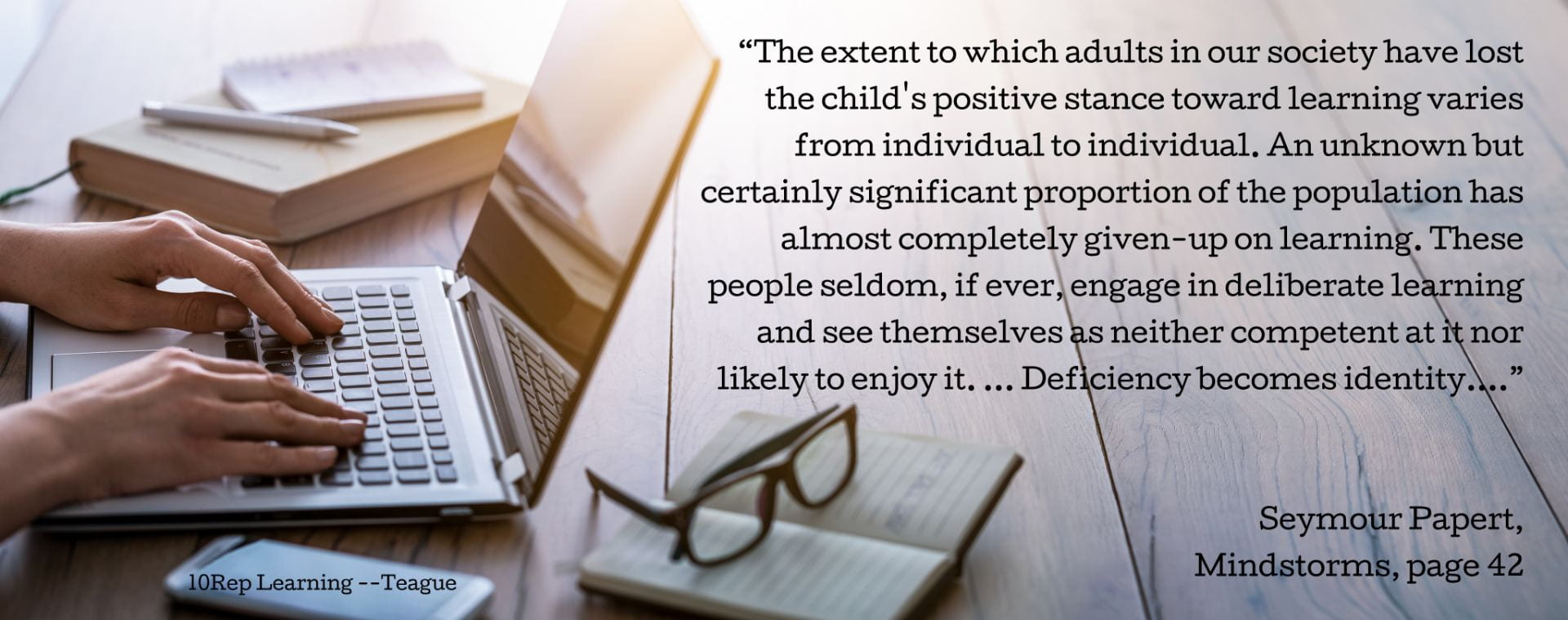
“…deficiency becomes identity, and inevitably learning is transformed from that early free play and exploration of the world to an habitualized task.” Papert, Mindstorms, page 42

free play


One of the key ideas that emerged during research for last night’s webinar was that students need a return (or, for the fortunate ones), a continuation of exploration and play. Papert’s quote from Mindstorms still resonates. Here’s hoping that this weekend brings opportunity for all of us to play and explore and have fun.


~~~

More Weekend Ed Quotes 

By

Weekend Ed. Quote ~ September 23

Give yourself time is an absurdly obvious principle that falls equally under heuristics and mathetics. Yet school flagrantly contravenes it by its ways of chopping time … Seymour Papert, A Word for Learning, In Constructionism in Practice, by Yasmin Kafai and Mitchel Resnick


time


~~~~

More Weekend Ed Quotes 


By

Weekend Ed. Quote ~ August 6

Seymour Papert Quote

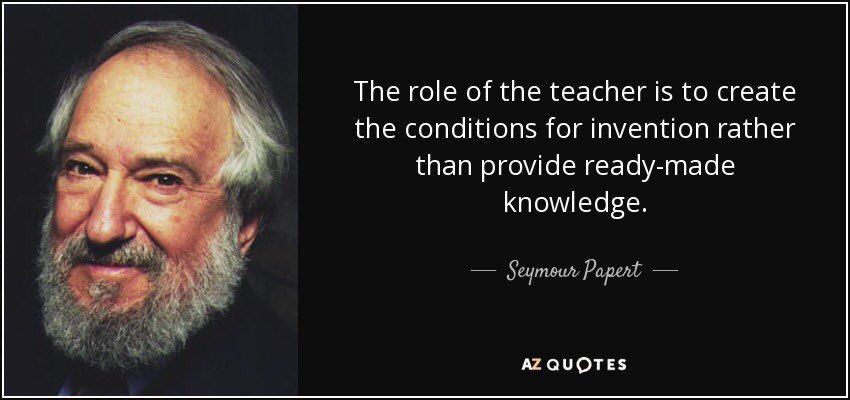
“The role of the teacher is to create the conditions for invention rather than provide ready-made knowledge.” ~Seymour Papert


~~~

More Weekend Ed. Quotes


Skip to toolbar